Sacred Valley of Peru: 10 Wonderful Things To Do
Last updated:
The Sacred Valley of the Incas (or Valle Sagrado in Spanish) is a popular tourist destination in Peru because of its proximity to Machu Picchu. Many visitors to Machu Picchu stay in Cusco. Those staying in Cusco, venture off to the Sacred Valley as it is lower in elevation than both Machu Picchu and Cusco to acclimate, which is vital for avoiding altitude sickness. Are you looking to spend a few days in Cusco or the Sacred Valley? In this post, I list 10 wonderful things to do in the Sacred Valley of Peru.
Disclosure: Booking your tour via the links in this guide will earn me a small commission at no extra cost to you. Earnings will go back to the maintenance of the travel guides provided on The Thrill of Pursuit. Thanks for your support.
<3 Dominique

What is the Sacred Valley of Peru?
The Sacred Valley of the Incas (aka Urubamba Valley) is a valley stretching 60 km in the Peruvian Andes. It is located about 20 km north of Cusco and stretches from Pisac to Ollantaytambo. The Urubamba River (aka Vilcanota River) is on the northern boundary of the Sacred Valley. The Urubamba irrigates the soil of the Sacred Valley, which makes it rich and ideal for agriculture.

The Sacred Valley and the Inca Empire
For centuries, various civilisations thrived in the valley because of its fertile soil. In 1420, the Incas from Cusco took over the region. This takeover happened during the reign of Inca Pachacuti – builder of Machu Picchu. The Incas believed that the Urubamba mirrored the Milky Way and considered the region sacred, giving the valley its name. The Sacred Valley became a major agricultural centre for the Inca Empire.
During the Spanish conquest, there was much destruction in the Sacred Valley not only from the conquistadors but from the Incas too. As Cusco fell, the Incas retreated from their capital and headed north. Before doing so, the Incas razed their own cities in the Sacred Valley and parts of the Qhapaq Ñan (the Andean Road System of which the Inca Trail was part of). This was to prevent the conquistadors from pillaging their treasures and to help contain the conquest. This tactic prevented the conquistadors from reaching Machu Picchu and therefore it remained intact for centuries.

The Sacred Valley after the Spanish conquest
After the Spanish conquest, people reduced the remains of the Inca structures to relics of a defeated empire. Andean ethnic groups moved in and built their communities, taking advantage of the fertile soil.
Today, the Sacred Valley is home to charming Andean towns along with preserved Inca archaeological sites. From impressive archaeological sites to vibrant communities and all with some of the most breathtaking backdrops on Earth, there are plenty of wonderful things to experience in the Sacred Valley.
1) Explore Ollantaytambo
Pronounced: oh-yan-TIE-tambo. Or Ollanta for short. Ollantaytambo is the gateway to the classic Inca Trail and Machu Picchu. There is great chance that you are staying in Ollanta for at least a night prior to your Inca Trail trek or that you are getting off the train in Ollanta to get to Machu Picchu.

Visitors can experience a wealth of history and living culture in Ollantaytambo. Located 62 km/ 39 mi northwest of Cusco, Ollanta is one of the most beautiful towns in the Sacred Valley. The town was built on a slope of a hill that is overlooked by the Inca archaeological site of the same name. What makes Ollanta special is that it has preserved almost 95% of the original Inca-era homes and are still used today.
The functioning water channels found around town were built by the Incas and are sourced from the ancient Inca citadel above the town. Ollantaytambo is the only town in existence that has preserved its original Inca urban layout, earning the nickname “The Last Living Inca City”.
The Ollantaytambo archaeological site is one of the most impressive in the Sacred Valley. Following Machu Picchu, it has some of the best masonry. When Inca Pachacuti took over the Sacred Valley, he ordered the building of city accommodations, a temple dedicated to the Sun, ceremonial rooms among others. Visitors can explore many of these projects in Ollantaytambo today.

2) Admire the Inca terraces at Moray
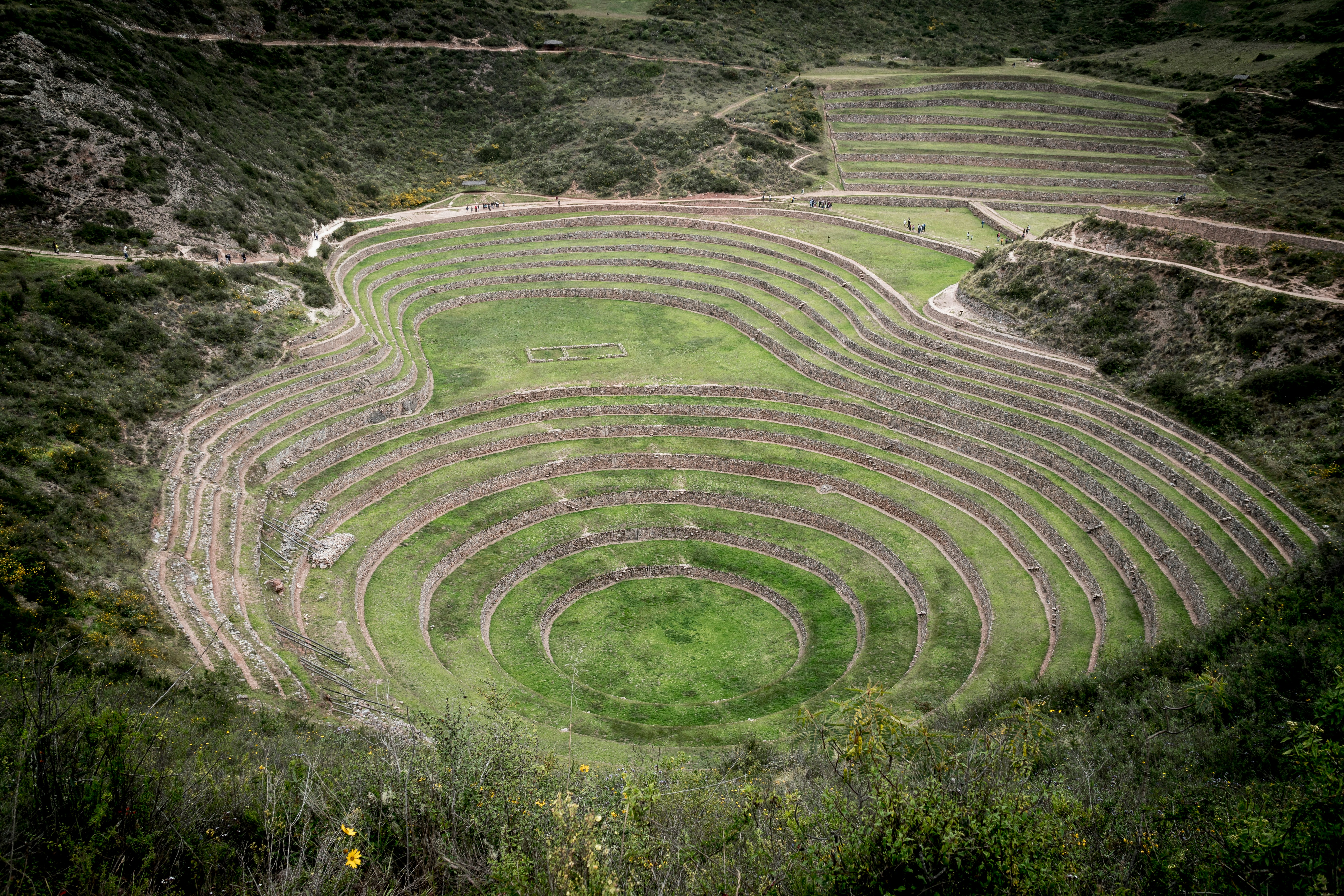
Moray is located 50 kms/31 mi northwest of Cusco. It is home to the most unique Inca archaeological site in the Sacred Valley. The Inca site at Moray are terraces formed in the shape of concentric circles. The depth, design, and orientation of the circles with respect to the sun and wind creates a temperature difference of as much as 15°C (27°F) between the top and bottom terraces. Researchers believe the Incas used these terraces as an agricultural laboratory.
3) Marvel at the Salineras de Maras
Maras is a town located about 40 km north of Cusco, adjacent to Moray. It is known for its salt evaporation ponds. These ponds have been in use to harvest pink salt since before the Incas took over the region.


About 3,000 terraces have been carved into the side of the Qaqawiñay Mountain. A salt water source located from within the mountain trickles into each terrace. Once the terraces fill with saline solution, the custodian of the salt terrace blocks the water source. This allows the salt water to evaporate under the intense solar radiation common in high altitude areas. After the water evaporates, custodians mine the salt crystals left behind from the terraces. Members of a salt cooperative own the salt terraces. To be a member of the salt cooperative, you have to be a resident of one (of two) nearby communities.

4) Visit Pisac
Pisac is another charming town where there is so much history and living culture to learn from. It is located 52 km/32 mi northeast of Cusco. The current town of Pisac was built on top of an ancient Inca town. At Pisac, the Incas had built agricultural terraces that enabled the production of surplus food. This surplus wouldn’t otherwise be possible at altitudes over 11,000 feet above sea level. These terraces are still in use today.

Pisac is also popular for its huge market traditionally held on Sundays, Tuesdays, and Thursdays. The market is where local artisans sell their products. The market has become so popular with tourists that it has taken over the Plaza de Armas every day of the week.
5) Learn about weaving in Chinchero
Chinchero is one of those quieter towns in the Sacred Valley but that doesn’t mean it is any less charming. Located 30 kms/19 mi north of Cusco, Chinchero best exhibits the traditions of the community. Chinchero is known for its weaving cooperatives. The town preserved its traditions in producing alpaca wool textiles which dates back hundreds of years. This town would be a great stop for those in search of authentic alpaca wool.
Chinchero was the site of a palace of Inca Túpac Yupanqui. During the Spanish conquest, the conquistadors destroyed the palace and built the village church on its foundations. Today, people know the site as the Chinchero archaeological site.

Sacred Valley Tours
To take the hassle of figuring out logistics, I have listed some of the best-rated Sacred Valley tours below.
- Check out this tour that covers Chinchero (weaver’s co-op), Moray, Maras, Ollantaytambo, Pisac with lunch at Urubamba.
- Alternatively, for a less hectic itinerary, check out this tour that would take you to Chinchero (weaver’s co-op), Moray, and Maras.
6) Support an artisanal cooperative
As you travel through the Sacred Valley, you will probably notice artisanal cooperatives in many of the towns (see the note on Chinchero for example). Between weaving, pottery, and community farms, I highly recommend supporting them.
When tourism began to boom in the Sacred Valley during the 1990s, many traditions and skills from the Peruvian Andes became endangered. This was because many young people abandoned their Indigenous roots in favour of getting jobs in the tourism and hospitality. The least Indigenous someone presented, the higher their chances were of getting hired for these lucrative jobs catering to foreigners. Many people also relocated to Cusco to become street sellers or to panhandle. The popularity of Machu Picchu inadvertently created an economic imbalance in the communities of the Sacred Valley. Moreover, Andean traditions and skills that survived the Spanish conquest were once again endangered; this time by mass tourism.
In recent times, people have recognised the importance of these Andean traditions. Concerted efforts to preserve and promote them led to the communities organising and creating artisanal cooperatives. By supporting these cooperatives, you are not only directly supporting local communities but you are also helping preserve the cultural legacies of the Sacred Valley.
Travel tip: G Adventures led me to discover all the co-ops mentioned in this section during their Inca Empire Tour. If you want to hike the Inca Trail to Machu Picchu AND support these local enterprises, booking through G Adventures would help you achieve all that without the hassle.

There way too many cooperatives for me to list here. But the point is to go out there and explore! Nevertheless, below are some of the co-ops that I highly enjoyed during my visit.
Women’s weaving cooperative of the Ccaccaccollo community
Ccaccaccollo is an Indigenous community located near Cusco. Like many other Indigenous communities in the area, they do not directly benefit from tourism that Machu Picchu attracts to the region. The community maintains its traditional way of life and work is mainly in agriculture. To supplement family income, the men work as porters and cooks on the Inca Trail during high tourism season. This is common practice for Indigenous communities across the Sacred Valley. Indigenous women are frequently excluded from educational and economic opportunities.
The creation of the women’s weaving cooperative in Ccaccaccollo helped create economic opportunities for the women of the community. In addition, the creation of the co-op has helped preserve the tradition of textile production within the community.

Qantus Wasi pottery workshop in Cuyo Chico
I stopped by the Cuyo Chico community for a pottery demonstration. Families from the Cuyo Chico community created a business out of their knowledge of the traditional adobe ceramic craft. During my visit, I learned about the ceramics process as well as the traditional brick-making methods used for homes throughout the Sacred Valley.


Parwa Community Restaurant in Huchuy Qosqo
Members of the Huchuy Qosqo community owns the Parwa Community Restaurant. The restaurant uses organic ingredients directly from its gardens and produce from local farmers and serves traditional Peruvian flavours. All proceeds from the restaurant goes towards sustainable community projects benefitting the Huchuy Qosqo community.

As explained in the previous section, the tourism boom in the Sacred Valley inadvertently created an economic imbalance in small, remote communities. The Parwa Restaurant provides employment opportunities in hospitality for the young people of the Huchuy Qosqo community.

Personal note: Travel is now more accessible than ever. Popular tourist sites like Machu Picchu are receiving record number of visitors which have adverse effects to the environment, local populations and, sometimes, the sites themselves. I try to be cognitive of how my love of travel affects the locals and their home and I will always advocate supporting local artisans and businesses.
7) Hike to Poc Poc waterfall
If you want to get off the Sacred Valley tourist circuit for an afternoon, consider hiking to Poc Poc waterfall. Poc Poc waterfall is a lesser known Sacred Valley destination that doesn’t receive many visitors.
Chinchero is the closest town to Poc Poc waterfall. Lush vegetation and dreamy Andean landscapes surround the waterfall. The hike is relatively easy and starts on an ancient Inca trail, surrounded by agricultural fields, mountains, and eucalyptus forests. The caveat here is that hike back to Chinchero would be more challenging as that will be the uphill portion of the hike.
Travel tip: to take the guess work out of how to get to Poc Poc waterfall check out this tour that offers hotel pickup and lunch. Alternatively, this guided tour which includes a hike to the waterfall is also available online.
8) Go rafting on the Urubamba River
For those looking for an adrenaline rush while out in the Sacred Valley, rafting tours on the Urubamba River are available. The Urubamba offers Class I to III rapids (some sections up to IV in rainy season) through scenic Andean landscapes and Inca archaeological sites. Check out this highly-rated tour that bundles rafting and ziplining over the Urubamba. Lunch and sauna session included. Make sure you properly acclimate to the elevation before you embark on this activity.

9) Hike to Huchuy Qosqo
I would only recommend this hike if you are, (1) properly acclimated to the elevation of the Sacred Valley and (2) are at a pretty decent level of fitness.
Inca Viracocha built Huchuy Qosqo (“Little Cusco”) as a royal estate in the 15th century. As the name suggests, this estate was modelled after the Inca capital and was an elegant country estate. When a revolt happened during Viracocha’s reign, he took refuge in Huchuy Qosqo while leaving his son, Pachacuti, to defend Cusco. Pachacuti was able to put down the revolt, deposed Viracocha and became the ruler of the Inca Empire. In 1534, the conquistadors looted Huchuy Qosqo and burned the mummy of Viracocha.
Today, the hike to Huchuy Qosqo is said to be one of the most stunning in the Sacred Valley, though it receives very few visitors. At 3,650 m (11,980 ft) above sea level, the hike rewards visitors with panoramic views of the Sacred Valley throughout the route. The hike is moderate, but it is long. Allocate about seven hours for the full hike.

Travel tip: I have not attempted this hike myself, and I have found very limited information online about the Huchuy Qosqo hike. That said, check out these new excursions offering guided tours to Huchuy Qosqo:
- this private tour starts in Urubamba and offers a guided tour by local to Huchuy Qosqo and the ‘Inca trail’ that. leads there.
- this tour offers pickup from Cusco and couples the guided hike with a stop in the community of Kallarayan for a special Andean barbecue and textile demonstrations.
- this tour offers hotel pickup and makes a stop in Lamay for a traditional lunch after the hike.
10) Stay at some one-of-a-kind accommodations
I can’t stress enough how absolutely stunning the Sacred Valley is. In recent years, hoteliers have taken advantage of the location and built some very unique stays. Check out some of these unique accommodations below!
- If you want to wake up suspended in a pod over the Sacred Valley, check out Skylodge Adventure Suites or alternatively Vertical Sky Suites
- If you wanted to sleep in a dome to watch the Milky Way and stars above the Sacred Valley, check out MISKI SAMAY DOMO BOUTIQUE
- For unbeatable views, check out Stardome Spiritual Experience
Where to Stay in Cusco
Cusco really is the best city to stay for exploring the Sacred Valley. I have consolidated some of the best-rated hotels in the city below by budget.
- For budget travellers, check out Tierra Viva Cusco Saphi Hotel and Viajero Cusco Hostel.
- If you’re working with a mid-ranged budget, check out Hotel Rumi Punku and Hotel and Mirador Los Apus.
- For a more luxurious experience, check out Antigua Casona San Blas and Palacio del Inka.
Reminders before you go…
- Stay connected while on the road for less with an eSIM. An eSIM is a digital version of a SIM card. Instead of buying a little plastic chip and swapping it into your phone, you just download an eSIM. It connects your phone to a local network in whatever country you’re visiting — no stores, no waiting, and no fiddling with tiny cards.
My favourite eSIM has been Airalo. Just make sure your phone is eSIM compatible. - Considering travel insurance for you trip? World Nomads offers coverage for more than 150 adventure activities as well as emergency medical, lost luggage, trip cancellation and more.
Note: I receive a fee when you get a quote from World Nomads using this link. I do not represent World Nomads. This is not a recommendation to buy travel insurance.

Hi! I’m Dominique.
I am the writer, photographer, and illustrator behind this travel blog.
I designed The Thrill of Pursuit to help you choose your next adventure, plan the journey, and help you navigate once you arrive at your destination.
Find out more on my About Me page.

Related Reads


Have you recently been to the Sacred Valley of Peru? Share your experience with us in the comments below!