15 Wonderful Things To Do in Antigua, Guatemala
Last updated:
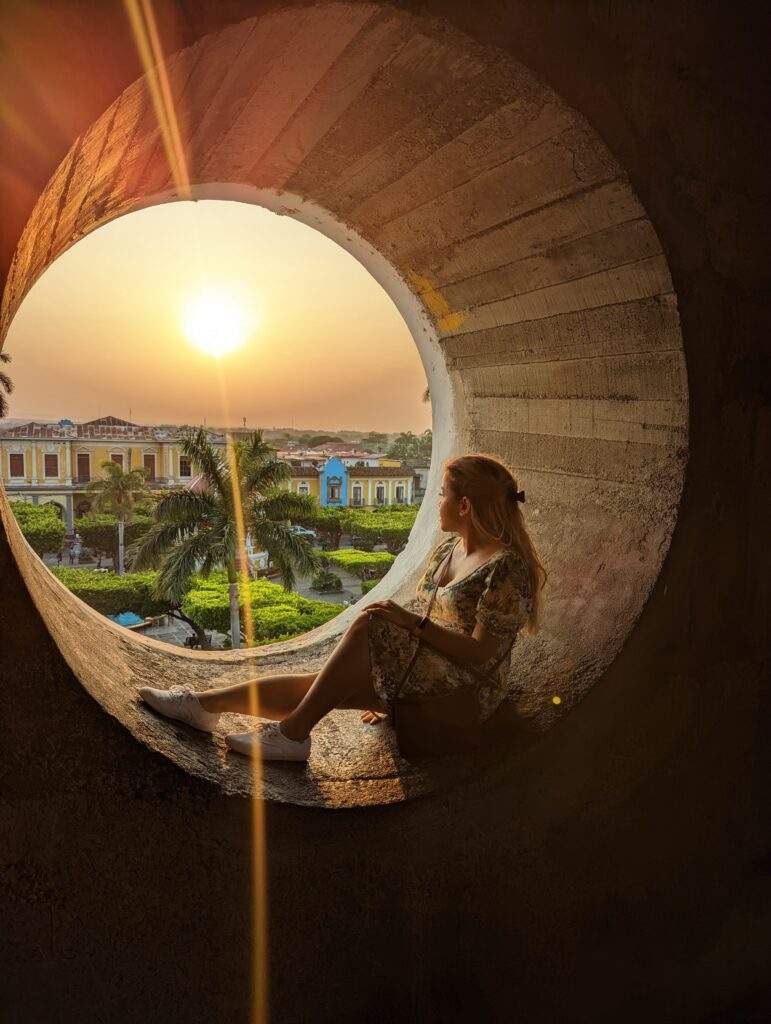
UNESCO designated Antigua as a World Heritage Site because it is the best preserved Spanish colonial-era town in Central America. There, you will find a walkable city with cobblestone streets, historic buildings and ruins, and colourful, local markets. Its proximity to natural wonders like the three looming volcanoes of Agua, Fuego, and Acatenango – also add to its beauty. For all these reasons, Antigua is my favourite city in Guatemala. Below, I share 15 wonderful things to do in Antigua, Guatemala.
Disclosure: Booking tours/accommodations via the links in this guide will earn me a small commission, at no extra cost to you. Earnings will go back to the maintenance of the travel guides provided on The Thrill of Pursuit. Thanks for your support.
<3 Dominique

1) Hike an inactive volcano
When flying into Guatemala City, you will notice two volcanoes piercing the clouds as you approach La Aurora airport. These two volcanoes plus a third are quite noticeable from Antigua, as the three volcanoes tower over the city. These three volcanoes are Agua, Fuego, and Acatenango.

Fuego is one of the most active volcanoes in Central America. It erupts roughly every 15-20 minutes. It was such a sight to behold seeing a puff of smoke come from the mountains on my drive from Lake Atitlán to the airport. Agua and Acatenango are both dormant volcanoes. Acatenango, which is right beside Fuego, offers one of the best views of Fuego.

The Acatenango hike is one of the most popular things to do in Antigua, Guatemala. The Acatenango hike is a challenging, two-day trek that would take you to the top of Volcán Acatenango. Adventurous travelers that make it up there are rewarded with breathtaking views over Antigua as well as a safe vantage point to watch Fuego erupt with gas, ash, and lava.

Acatenango Tour Companies
It is possible to hike Acatenango independently without a guide ONLY if you have no intention of staying overnight to watch the eruptions. However, most travelers opt to stay overnight and for that you DO need to join a tour group. Tour groups tend to book up fast. Below are some of the best rated companies offering Acatenango overnight tours.
- OX Expeditions. OX is reviewed well for its delicious food, base camp location, and the condition of their rental gear. They also get reviews for their courteous and professional guides.
- Experience GT. Past clients rave about this tour company’s attentive guides, delicious food, and having one of the nicer base camps on Acatenango.
- Pachamama Tours. Tours booked through this company funds “I Am Hope Guatemala”, a non-profit that provides shelter, education, child care support, and psychological guidance to victims of domestic abuse. Past clients have raved about their attentive guides.
2) Hike an active volcano
If you’re concerned about your fitness level for the Acatenango hike or are short on time, you can try hiking Volcán Pacaya instead. At 2,552 m (8,373 ft), Pacaya is not nearly as high as Acatenango (at 3,976 m /13, 045 ft) and can be summited within a couple hours. You have the following options for hiking Volcán Pacaya: a day hike, a sunset hike, or you can do an overnight trip in order to enjoy a sunrise and sunset on Pacaya. Unlike Fuego, Pacaya has not erupted since 2021; it emits puffs of smoke and toxic gasses, however.

As mentioned above, it takes about two hours to reach the summit of the Pacaya hike. To level set expectations, the summit of the hike is not actually the summit of Volcán Pacaya. The summit of Volcán Pacaya emits toxic gasses and is so hot that it would melt your hiking boots. The summit of the hike provides views of the conical Pacaya volcano. The base of Pacaya offers plenty of geothermal activity where hikers can roast marshmallows (provided by the mandatory guides) and even cook pizza (you would need to pre-book this experience as it is not always available). The Pacaya hike also offers fabulous views of Antigua, Acatenango ,Fuego, and Agua (depending on the trail you take).

Pacaya Tours
To hike Pacaya, having a guide is mandatory. Below are some of the best rated tours departing from Antigua.
- I booked this tour which included pickup and dropoff at my hotel in Antigua. They also offer a Pacaya tour at sunset. The tour group was bigger than what I expected (we were no more than 20 people), but everyone hiked at their own pace that it didn’t matter so much once you were on the volcano. Also, it was nice to have people to talk to on the bus.
- For a more intimate experience, check out this private tour.
- For those wanting to camp overnight to have a sunrise and sunset experience on Pacaya, check out this tour.
3) Admire the colonial-era architecture
As mentioned earlier, UNESCO designated Antigua as a World Heritage Site largely because it is the best preserved Spanish colonial-era town in Central America. It’s no surprise, then, that admiring the town’s colonial-era architecture ranks among the best things to do in Antigua, Guatemala!
Below is a list (and map) of the preserved colonial monuments around Antigua.
Palacio de los Capitanes Generales
In English: Palace of the Captain Generals. This is the first two-story building built in Antigua. It served as the home of the Captain General during the Spanish colonial era. The Captain General ruled all of Central America from this building. Today, it houses the headquarters of the Guatemala and Antigua tourism governing bodies, the National Police, government offices (of the Sacatepquez Department) and the National Museum of Guatemalan Art.

Palacio del Ayuntamiento
In English: City Hall. You’ll find this 18th-century building across from the Palace of the Captain Generals in Antigua’s Central Park. In addition to offices and shops, it houses the Museo del Libro Antiguo (Museum of Antique Books), which showcases the history of Guatemalan printing.
La Merced
This is a bright yellow, colonial church decorated with intricate, white filigree. It was built in the 18th century and was designed to withstand the frequent earthquakes of the region. At the last Thursday evening of every month, you can expect to catch a candlelit procession accompanied by a choir of bells and firecrackers. During Semana Santa, two of Antigua’s famous Semana Santa processions originate from La Merced.

Hospital de San Pedro
Dominican friars founded the San Pedro Hospital and its adjacent church in 1663. They dedicated it to Franciscan priest Pedro Betancourt, who established Antigua’s first hospital. Today, the building serves as a multi-service facility for Antigua’s most disenfranchised. It is now managed by Franciscan friars. You can find Brother Pedro Betancourt’s tomb three blocks away at San Francisco Church, another restored colonial building in Antigua. San Francisco Church is a popular place of pilgrimage for Guatemala’s faithful.

Universidad de San Carlos de Guatemala
USAC, for short, is the largest and oldest university in Guatemala. It is also the fourth oldest university in the Americas. USAC was Guatemala’s only university until 1954 and remains to this day as its only public university. After the devastating 1773 earthquake, the university moved most of its functions to Guatemala City, where the main campus still operates today.
The restored Antigua campus of USAC now serves as a museum celebrating the university’s rich history. It also houses the Museo del Arte Colonial.

4) Explore the ruins of colonial Antigua
What we know today as Antigua was once called the Santiago de los Caballeros de Guatemala when it served as the capital of all of Central America. A 1773 earthquake would devastate the city, prompting the government to move the capital to what we know today as Ciudad de Guatemala (Guatemala City) in 1776. Antigua Guatemala translates to “Old Guatemala” in English. When officials moved the capital, they referred to the destroyed city as Antigua Guatemala and the name stuck. Officials ordered everyone to abandon Antigua, though not everyone followed those orders.
Recurring earthquakes and government corruption severely stunted the recovery of Antigua. Since 1773, rebuilding was limited to what was absolutely necessary to the community. One of the best things to do in Antigua, Guatemala is to explore the ruins of the great colonial buildings of the former capital of all of Central America. In this section, I list some of the most notable ruins.
Related read: Antigua, Guatemala: 5 Essential Travel Tips
Catedral de San José
The construction of the original church began in 1545. Frequent earthquakes in the region would delay its completion. A 1669 earthquake would destroy the original church and a second one was built on site in 1680. That second church would be destroyed by the 1773 earthquake.
For a time, the church was abandoned and its interior was used as a cemetery. In the early 19th century, a request was made to use the ruins of the cathedral as a parish. The parish of San José has occupied (only) the entrance of the original cathedral since 1832.

La Antigua Catedral Metropolitana de Santiago
Right next to the parish of San José is the entrance to the ruins of the Old Metropolitan Cathedral of Santiago. Here, you can explore the remains of the original church of Santiago that was completed in 1680.

Iglesia y Convento de Santo Domingo
Founded in 1542, Santo Domingo was once the richest and biggest monastery in Antigua. After the 1773 earthquake, its ruins were pillaged for building material. In 1970, an archaeologist would purchase the grounds of the old Santo Domingo monastery as a private residence. Extensive excavations were done before the Casa Santo Domingo Hotel took over the property in 1989.
It is a little tough to explain if the luxury hotel is located at the ruins or if the ruins are housed within the hotel. Either way, anyone can explore the hotel grounds to see monastery ruins, the Cavalry Crypt, and the six permanent museums dedicated to Maya culture and colonial life in Guatemala.

Convento Santa Clara
The Santa Clara convent was founded in 1699 and was destroyed during the 1773 earthquake. Convento Santa Clara in Antigua is a large complex and is probably the most impressive of the ruins in the city. Much of the details of the original structure remain intact giving visitors a glimpse into what colonial life was like for a nun (in case you were curious). On the grounds, you can find impressive colonial structures, beautiful gardens and an upper level arcade that is still in place. The grounds are stunning and is a popular wedding venue.

Convento de Capuchinas
Built in 1736, this convent was seriously damaged during the 1773 earthquake. It was abandoned when the Spanish Crown ordered everyone to abandon Antigua in 1776. In recent decades, restoration projects have cleaned up the site to give visitors an idea of how the nuns of the convent lived (again, if you were curious to know). These cloistered nuns ran an orphanage and a woman’s hospital during their time in Antigua.

5) Go on a walking tour of the city
The most efficient way to see all the monuments mentioned above would be to join a walking tour. There is so much to learn that it would be optimal to have a knowledgeable local show you around. Below are some of the walking tours of Antigua that I booked and loved.
- I booked this “free” walking tour of Antigua via GuruWalk. The tour that I booked (and linked above) was so thorough and went over the time allotted. I loved every minute.
GuruWalk is a website that connects travelers with guides around the world who offer free walking tours in their city. The tours are free in a sense because there are no set prices for the tours but you should 110% tip your GuruWalk guide for their time at the end of your tour. - For a unique experience, I booked this evening walking tour of Antigua with a special focus on eerie Guatemalan and Mayan folklore. The tours are run by Luis who has bottomless knowledge on all things Mayan culture. When I met Luis, I was coming from the Mayan community of Uaxactun which is deep in the Peten jungle. I had just finished filming The Giving Tree in Uaxactun, where I had learned so much from the community. The Giving Tree is a documentary short (and my directorial debut!) about gum collectors living within the Maya Biosphere Reserve. The average Guatemalan is probably not familiar with Uaxactun. Luis knew exactly where I had been and understood what I was filming. I was so impressed. He runs other walking tours around Antigua (like this one) and recommend him to those interested in history and Indigenous cultures.

6) See the Santa Catalina Arch at sunrise
The Arco de Santa Catalina is the most iconic structure in Antigua. The arch was built in 1694 to allow nuns of the Santa Catalina convent to cross the street without being seen. Not surprisingly, it gets very busy at the Arch. I got up early one morning to see the Arch because I wanted to take pictures without the crowds. Antigua at sunrise is absolutely serene and beautiful. I recommend sacrificing one day of sleeping in to walk her streets before everyone else wakes up.


7) Take a picture at Cerro de la Cruz
Cerro de la Cruz (Hill of the Cross) is a lookout point offering some of the best panoramic views over Antigua. A guide isn’t necessary to enjoy this spot. You can hike to it from the city center but expect to go up many stairs. Alternatively, you can take an Uber or a tuk-tuk there.

8) Observe a famous festival
One of the things that makes Antigua, Guatemala so beautiful and unforgettable is its rich culture and traditions and the obvious pride and passion the locals have for them. Antigua is at her most beautiful during one of her famous festivals. The city bursts with so many colours and textures and becomes such a feast for the senses. You may want to time your visit to Antigua, Guatemala with some of her famous festivals listed below.
Semana Santa
Semana Santa (Holy Week) is an annual religious observance in the Catholic faith that commemorates the entry of Jesus Christ into Jerusalem through to his crucifixion and burial. It occurs on the week leading up to Easter.
Antigua’s observance of Semana Santa is one of the largest and most famous in the world. Their celebrations blends Catholic practices with ancient Maya traditions which evolved into something uniquely Guatemalan. Guatemala’s Semana Santa celebrations have been inscribed on the UNESCO list of Intangible Cultural Heritage.
During Semana Santa, expect Antigua’s streets to be decorated with alfombras – temporary, intricate carpet designs made from coloured sawdust and flower petals. You can also expect elaborate processions of locals dressed in purple and white robes carrying massive floats on their shoulders. The floats depict scenes from the Stations of the Cross. The processions walk on the alfombras, sweeping the intricate designs away.
Semana Santa occurs on the week leading up to Easter. Every year, Easter is determined as the Sunday following the first full moon after March 21st (aka the March equinox).

Festival de Barriletes Gigantes
Translated into English: Giant Kite Festival. The Kite Festival is annual tradition that falls on All Saint’s Day. Much like Día de Muertos, the Kite Festival honours deceased loved ones.
The Giant Kite Festival does not take place within Antigua in itself but rather in two small towns close to Antigua: Santiago and Sumpango. Throughout the year, the artists work on giant kites. These kites pay tribute to the communities’ legacy and each one tells a story. The intricate designs can depict anything from religion, Mayan traditions, family histories, and current social and political issues. The creation of the kites become a community effort as much fundraising is required to create them.
The kites are then flown on November 1st (All Saint’s Day in the Catholic calendar) at the communities’ cemeteries. I have heard two explanations on this: (1) the kites hold messages for deceased loved ones and are flown as close to heaven as possible so that the messages are received and, (2) the kites are meant to direct any lost souls wandering the cemeteries to heaven. The Giant Kite Festivals are on the tentative list to be inscribed as a UNESCO Intangible Cultural Heritage.

Travel tip: if you’re interested in attending the Giant Kite Festival in Guatemala, check out this tour that would take you to Sumpango and includes a traditional meal with local families or this tour that would take you to Santiago AND Sumpango.
Fiesta de Santiago
Many Guatemalan towns have a patron saint. The towns hold annual celebrations on the feast day of their patron saint. Antigua’s patron saint is St. James whose feast day is celebrated on July 25th. Expect Antigua to celebrate St. James’ feast day with processions, concerts, and folkloric dancing.
9) Take a cooking class
While I was in Antigua, I took a cooking class where I learned how to make tamales, chiles rellenos, and the distinctly Guatemalan pepián, among other things. It was one thing to eat these dishes at a restaurant, but learning to make them with a local was an entirely different experience altogether. Prior to the cooking class, the chef and I went to Mercado Central to shop for the ingredients. He walked me through the spices and produce commonly used in Guatemalan cuisine and had the opportunity to purchase fresh ingredients directly from local growers. Taking a cooking class with a local is one of the most culturally immersive things to do in Antigua, Guatemala.


Travel tip: find the exact market tour + cooking class experience that I booked here!
10) Go on a street food tour in the towns around Antigua
If cooking classes don’t interest you, consider going on a street food tour! I love street food tours as I get a better understanding of the snacks and quick meals that are popular with the locals. In addition, by having a local show you the most popular establishments, you also get insider knowledge on the best places to go. Street food tours are my favourite way to get my bearings on a new place.
While in Antigua, I went on a street food tour that took me to the surrounding villages. I absolutely recommend this street food tour with Milton from Foodietenango. His tour took me to fascinating small towns like Ciudad Vieja – the capital of Central America before Antigua. The town would be devastated by the 1541 eruption of Volcán del Agua (which was what prompted the Crown to move the capital to Antigua). In addition, Milton took me to the best places to get shucos, gringas, churros and other treats.

Travel tip: you will notice that “tenango” is a common suffix in many places in Guatemala. In the Nahuatl, “tenango” means “the place of” or “town”. So Quetzaltenango for example can be translated to “the place of the quetzal”.
11) Visit a coffee plantation
Coffee is a source of pride for Guatemalans. The elevation around Antigua create the ideal environment to grow coffee. There are plenty of coffee plantations to be found near Antigua that offer tours. A tour of a coffee plantation offers visitors a walk through of the coffee producing process – from seed to cup.
From this experience, not only do you learn about coffee production but you will also get a glimpse of rural life in Guatemala. As well, you get the opportunity to support small farmers and the local community. If you’re interested in visiting a coffee plantation while in Antigua, check out this tour which will take you to San Pedro Las Huertas.
Travel tip: there are other farm to table type tours available in Antigua. Chocolate making workshops for example are plenty. I do not mention them in this list as those activities are available in other places in Guatemala (check out 10 Best Things To Do in Semuc Champey) but coffee plantation tours are not as common.
12) Indulge in a drink or two
Antigua has plenty of breweries and cocktail bars. I visited too many of them to count. There are plenty of establishments offering views of Antigua and the surrounding volcanoes from their rooftop bar. The one thing that stood out to me at Antigua was the number of speakeasies.


My favourite speakeasy is Ulew Cocktail Bar. It is located within the Antigua Brewing building. At the brewery, you will notice a red telephone booth. The telephone booth is the entrance in Ulew. I loved Ulew because each cocktail is custom to your taste. There’s no menu. You simply tell your server your favourite spirit and flavours and the mixologist will craft a custom drink for you. Each drink is between 70-80 Q.


13) Visit an art museum
When it comes to art galleries, Antigua has options for its visitors. Below are some art galleries and museums that are housed within the city’s most iconic buildings, allowing you marvel at the art as well as the architecture.
- MUNAG (National Museum of Guatemalan Art) which is housed within the Palacio de los Capitaines Generales.
- Museo del Arte Colonial which is housed at the old Universidad de San Carlos de Guatemala campus.
- Museum of Pre-Columbian Art and Modern Glass, as well as the Galleries and Art Rooms located within Casa Santo Domingo.
14) Find the mirador that offers the best views over Antigua
Antigua is surrounded by volcanoes and hills that loom over it. Is it surprising to know that there many viewpoints offering breathtaking views over Antigua? Below are some of the most popular viewpoints or miradors in/near Antigua:
- Cerro de la Cruz
- Hobbitenango
- Altamira

Travel tip: to save the time on navigating and the hassle of figuring out transportation, I booked this private tour of Antigua’s mountaintops.
15) Go on a day trip
As previously mentioned, Antigua is an unmissable stop on many Guatemala and Central America itineraries in part because of its central location. Therefore, Antigua is the perfect base for day trips to get deeper into the heart of Guatemala. If you are short on time during your visit to Guatemala, below are some excellent day trip ideas departing from Antigua:

- Hobbitenango
- Altamira
- Chichicastenango (on Thursdays or Sundays)
- Iximché
- Lake Atitlán (but I would only recommend this if you are unable to stay overnight at the lake)
Related read: 5 Best Day Trips from Antigua, Guatemala
Where to stay in Antigua
I have consolidated the best-rated hotels in Antigua below.
- For budget travelers, check out Alana Hotel by ISH or The Purpose Hostel.
- If you have more of a mid-ranged budget, check out Casa Noble Hotel or Hotel Candelaria Antigua.
- For a more luxurious experience, check out El Convento Boutique Hotel or Hotel Museo Spa Casa Santo Domingo.
Related reads


What was your favourite thing to do in Antigua, Guatemala? Did you have any questions for your upcoming visit? I would love to hear from you in the comments below!